Disposable cameras at a wedding: what they cost, what they do, and what the two of you actually need
An honest look at the disposable cameras on the tables, with checked prices for cameras and developing, at the photo booth next to them, at the alternatives that handle the guest photos, and at the question every one of them leaves open: who takes a picture that belongs to the two of you?
August 6, 2026 · 11 min read · Przemek Zajfert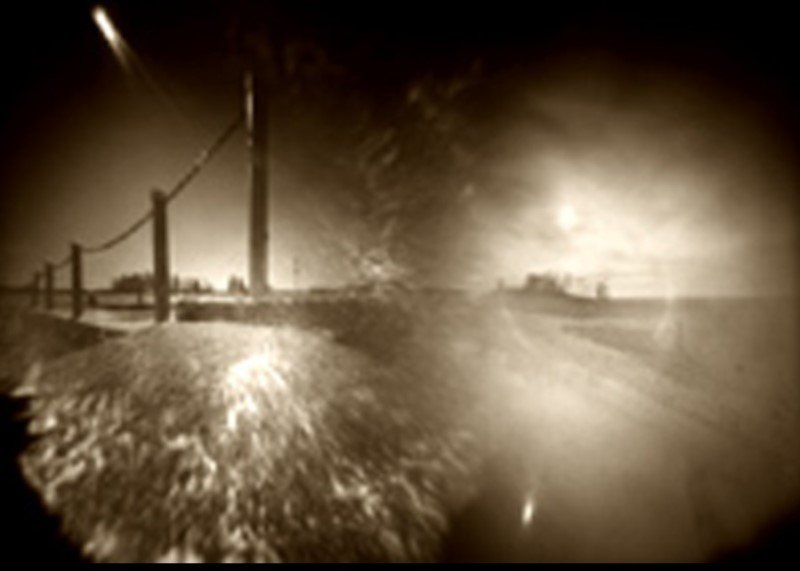
Disposable cameras at a wedding are a lovely idea with a bill that hardly anyone adds up in advance. This article adds it up, with prices we checked, each with its date, and then answers the question that every one of the options leaves open.
What can I use instead of disposable cameras at a wedding?
For your guests' photos, a QR photo app, which costs less than any route with disposables, or a photo booth if you want bright pictures printed on the spot. For a picture of the two of you, none of those, but Both In Time, a cardboard pinhole camera: you expose one half on the wedding day and the other on a later anniversary.
| Option | Cost | Price read | Who takes the picture |
|---|---|---|---|
| Disposable cameras, twelve from multipacks, drugstore developing | about 113 € plus prints | 31 July 2026; dm price list dated August 2023 | the guests |
| Disposable cameras, twelve single cameras, mail-order lab with scans | about 469 € | camera 16 October 2026, lab 23 October 2026 | the guests |
| Photo booth, one wedding day | 179 to 299 € | 23 September 2026 | the guests |
| QR photo app, wedding gallery | 39,99 to 49,95 € | 23 September 2026 | the guests |
| Both In Time, one pinhole camera for two | 79 € incl. VAT | shop price, read 23 October 2026 | the two of you |
So there are really two questions hiding in the one you asked. If you mean your guests' photos, the budget decides, together with whatever bothered you about the disposables in the first place. If you are after a picture of the two of you, the answer is less comfortable: none of the guest options. Every one of them organises what other people see of your day. An image that belongs to the two of you sits in a separate, almost empty category, and we answer that one before the price lists rather than after them.
First, though, a proper look at what actually sits on the tables.
What the disposable camera on the table really does
Start with the case in its favour, which is real enough. A disposable camera has no screen. Whoever picks it up shoots and puts it back down, instead of checking, retaking and sharing. Children love them. And because nobody sees the results right away, something happens that no photographer can plan: the look across the table, an aunt mid-laugh, the best man with his eyes shut. Weeks later, prints come back that nobody expected. That element of chance is the real reason to buy them, and it is hard to argue with.
Now what speaks against it. The lens is fixed focus, the flash reaches a few metres, and wedding receptions happen indoors, in the evening. A large share of the frames come out dark, blurred or both. Then there is the bill, and it depends almost entirely on where you buy and where you have the film developed. We worked out both ends for twelve tables, one camera per table, at German prices.
The cheap route: multipacks sat at 6,32 to 6,65 euros per camera on the comparison site kameratrends (kameratrends, read 31 July 2026), so about 78 euros for twelve. Developing at the drugstore chain dm costs 2,95 euros per disposable camera handed in, and a 10 x 15 cm print 0,08 euros, according to the last price list we could find (dm price list, dated August 2023, read 6 October 2026). About 113 euros in total, plus prints. How current the dm price still is we cannot say: dm's photo service page no longer names a price, only the notice in the store (dm photo service, read 23 October 2026).
The expensive route: a single Kodak Fun Saver with 27 plus 12 exposures cost 19,49 euros at the German retailer Foto Erhardt (retailer page, read 16 October 2026). At the mail-order lab Mein Filmlab, developing and scanning costs 16 euros per 35 mm film at the smallest scan size, plus a 3,60 euro handling fee for disposable cameras (price list, read 23 October 2026). Twelve cameras come to 469,08 euros that way, with scans instead of paper prints.
In the US, multipacks cost about what single cameras cost in Germany: a wedding photographer's guide lists a Fujifilm 10-pack at 199 dollars on Amazon (thedrunkweddingphotographer.com, read 23 October 2026), about 20 dollars a camera before any lab sees it.
So anything between 113 and 469 euros is possible, and a photo booth with a published price (179 to 299 euros, see below) sits in between. Until this version, this article said cameras and developing together cost 60 to 95 euros and that we could not name a source for the figure. Both halves were wrong: the band came from the kameratrends pack prices we had checked in July 2026, and it covered the cameras only, not the developing. And you pay for every frame, including the fourteen pictures of the ceiling.
And a point that appears in no product description: at the end of the evening somebody has to walk the room and collect the cameras. Every one left on a table, or half exposed in a jacket pocket, is paid film with no pictures on it. Choosing disposables means choosing that midnight round as well.
The alternatives that solve the guest job
Four options do the same job, each with a different trade. We name the actual providers and devices rather than talking about "apps" and "booths" in the abstract. A warning on all of them, since this article is written from Germany: the prices, the providers and the wedding guides quoted below are the German market, because that is the market we sell into and can check. The mechanics carry over anywhere; the euro figures do not.
QR photo apps. A code on every table, guests shoot with their own phones, everything lands in a shared album immediately. The strengths: every phone today is a better camera than any disposable, there are no development costs, and you have all the pictures the same evening. The weaknesses: guests spend the evening with phones in their hands, which may be exactly what you did not want, and what you end up with is one more digital folder. And an album that belongs to everyone belongs to nobody in particular: that is our objection to it, and it is an argument, not an observation: how often such albums actually get opened later is something we have not measured and do not know. This is also the cheapest option: FridaySnap charges 39,99 euros once for the wedding gallery, down from 85,99, and WeddySnap 49,95 euros, down from 59,00 (both from the providers' own pages, read 23 September 2026). Where the two differ sharply is storage, and that is the clause worth reading: FridaySnap's own page promises the gallery "für immer", forever, while WeddySnap stores for 12 months and sells the extension up to lifetime storage as an option. Both are defensible. They are not the same product.
Photo booths. A camera on a stand, proper light, often a printer. The strengths: reliably bright, sharp pictures, printed on the spot, and the queue in front of the booth entertains itself. The weaknesses: rental cost, setup, floor space, and every picture looks like the same corner of the room. Few providers publish a price; the ones that do land at 299 euros for the wedding package (foboxy) or from 179 euros (top-fotobox), both read 23 September 2026.
A photographer. The most expensive option, and the only one where somebody records the whole day on purpose. Someone who takes the craft seriously delivers images none of the other options can reach. The trade is obvious: budget, and a person with a camera present all day.
Digital cameras on the tables. A few cheap compact cameras instead of disposables, and early-2000s digicams are the fashionable choice right now: better in low light, no development costs, reusable. Used bodies in decent condition start at about 50 euros each, according to the German wedding guide The Heritage Wedding (whose page is dated September 2025). In exchange, somebody has to collect the memory cards after the party, sort the files and return the cameras. It is the sensible version of the table camera, with a little less charm and a little more logistics.
Two more options turn up regularly in German wedding guides and belong here for completeness. Instant cameras, in practice a Fujifilm Instax or a Polaroid, deliver what the disposable promises and often fails to keep: a picture in your hand straight away, bright enough for an indoor room, writable on the back. The price sits per frame, roughly 1 to 2 euros per picture, and a party full of enthusiastic guests can overtake any booth rental on cost. (That figure also comes from The Heritage Wedding, whose page is dated September 2025, so it is not a price from today, and film prices rise.) And the mirror booth, the photo booth's wall-sized cousin: the same idea technically, the same fixed corner, a higher rental fee, more spectacle.
What none of these options can do
Now the point where this article changes direction, and it fits in one sentence: every option above exists for the guests' photos. The app's album belongs to everyone. The booth strip ends up on a friend's fridge. The reportage shows you, but somebody else made it. None of it is a picture the two of you took, just you, for nobody else.
On the day itself the gap does not register, because too much is happening. It registers later, once the albums are sorted and everything that exists of that day was taken from somebody else's point of view. You were the subject of the day and nowhere its photographers.
That category, the couple's own camera, is almost empty. Hardly any product takes it seriously. Yet the idea is simple: not a hundred pictures by everyone, but a single one by the two of you.
Which analog pinhole camera can two people expose years apart?
Both In Time. A cardboard pinhole camera, two holes side by side, a single A5 sheet of photo paper inside, the image on it about 10 x 15 cm. One person exposes one half, tapes their hole shut and seals the camera with a handwritten date. The second person exposes the other half whenever the time comes: in 3 weeks, in a year, on a tenth anniversary. Only once both halves are exposed does developing produce an image, and it exists exactly once.
The question gets asked often and answered badly, so here is the honest lay of the neighbourhood. Analog pinhole cameras exist in good variety, and nearly all of them are built for one person and one exposure. A tin can records the sun's path over months, hung by one hand and taken down by the same hand. A wooden roll-film body is a fine instrument for a photographer working alone. A plastic camera with several holes makes a multiple exposure, but in one moment and in one place. We have worked through those three neighbours one at a time, in their own articles: the Solarcan alternative, the ONDU alternative and the Lomography alternative. Each of them does something we cannot. What none of them does is expose separately and hold the wait in between, because they were not built for it.
That we can started as an awkward problem rather than a product. In 1999 two artists wanted to make one picture together and were sitting too far apart to do it, one in Stuttgart and one in Berlin. So Przemek made a camera obscura that had two holes in it rather than one. Six years later that turned into a worldwide project: two holes of the same camera auctioned off every week to two strangers, 2072 holes by the time it closed in 2025. Holes 75 and 76 were bought by Keith Fyfe in Sydney and Steven Schmiedeskamp in Lincoln, Nebraska, 16,000 km apart, and both of them aimed the camera across level ground at a low sun. What came back was a horizon running through both halves that nobody had agreed on. That picture is at the top of this page. The whole story is in the article on camera obscura 2005/1 to infinity.
Technically there is nothing complicated about it, and that is deliberate. No lens, no shutter: the hole is 0.3 mm and is pierced by hand with an acupuncture needle. Depending on the light, one exposure takes 4 seconds or several hours. Holding still together for four seconds is a small ceremony of its own on a wedding day, and you can see it in the picture afterwards. Each camera is made by hand in Stuttgart and stamped with a serial number, counting up from 0001.
Przemek has worked with camera obscura for more than 40 years. Across both of his participatory projects more than 13,000 people have taken part, around 7,000 photographs, each exposed for at least 7 days. That is why this camera is not a craft-kit idea but the small, giftable version of a way of working that has existed for decades.
Photo booth alternatives at a wedding: what the booth costs and what it is not for
That answers the question for the two of you, and the rest of this article belongs to the guests again, starting with the device that takes up the most floor space at a wedding.
People who go looking for an alternative to the booth usually do it for one of three reasons. The first is price. A wedding-day booth package from the German providers who publish their prices openly sat between about 180 and 300 euros in September 2026: foboxy at a flat 299 euros, top-fotobox from 179, usually with unlimited prints, props and an online gallery. The comparison list at hochzeitsportal24 runs much wider, from 129 euros for fobotogo's basic package up to 1,350 euros and above for a Fotobus: a converted VW camper van that parks outside. If price is the reason, the QR app is the direct answer: same job, a fraction of the sum, no equipment for anyone to set up. And if you were going to swap the booth for disposables to save money, put the sums from above next to it: via multipacks and a drugstore lab the disposables come in under the booth, as single cameras through a mail-order lab well over it.
The second reason is space. A booth needs a corner, power, and a route to it that does not cross the dance floor. In a full room that is a genuine argument and it cannot be negotiated away.
The third is the one the price lists do not show: the results are uniform. Every picture is made in the same spot, in the same light, against the same background. This is exactly where disposable cameras on the tables are the better alternative to the booth rather than the worse one, because they travel with the guests through the evening. Instant cameras do the same, with better pictures and a higher cost per frame. A retro camcorder on a table solves the same job in moving images; it rents cheaply, though we found no provider publishing a day rate for one.
What the booth genuinely does well, and we are not talking it down: a brightly lit, sharp picture of every guest, carried home in their hand. No app, no disposable camera and no reportage photographer delivers that with the same reliability. If that is your goal, rent the booth and save somewhere else.
Who the booth is not for: the two of you. It stands in its corner and photographs whoever steps in front of it, and that is not a weakness of the machine, it is its job description.
Deciding on the guest photos
Choose by what would have bothered you about the disposables. If it was image quality: booth or photographer. If it was the cost: the app. If it was collecting and developing: the app again. And if the chance element of an analog table camera matters more to you than any of that, then disposables are not a wrong choice, they are a choice with a known price: you pay in blurred frames and development costs for a kind of charm the digital options do not deliver. Nothing here wins outright. They are four tools for one job, and all four get it done.
The camera for the two of you, not for the guests
Back to the camera with the two holes, because one question about it is still open: what happens afterwards? No lab develops it. You do, at your own kitchen sink under a red bulb, with instant coffee, vitamin C and baking soda: ingredients for under 5 euros, 5 minutes of work. How that works, and why coffee of all things is a developer, is explained in the article on Caffenol basics. What you then watch appear in the tray is an image two people worked on at two different times.
To put the cost next to the numbers above: twelve disposable cameras plus developing run between about 113 and 469 euros and take pictures for everyone. A booth costs 179 to 299 euros for one day and takes pictures for everyone. This camera costs 79 euros, is developed in your own kitchen, and takes a single picture that belongs to nobody else. It is not a replacement for the guest photos, and it is not trying to be. It covers the one part of the day that none of the options above is responsible for.
How the wedding day itself plays out, who is allowed to make the exposures, and what happens if the seal breaks early, is covered on the page Both In Time for weddings. If you are not exposing the camera yourselves but giving it to a couple, the article on the wedding time capsule is the one you want. The camera itself, with paper, needle and red foil included, is in the shop.
In the end you have both
The two jobs do not compete, they do not even touch. For the guests you pick one of the four tools above, by budget and taste, and you get a full album. For the two of you there is a sealed camera on a shelf afterwards, with a date in your own handwriting and half a picture inside, waiting. The album you will open often in the first weeks. The camera you open only once the second part of the story has happened.
Common questions
- What can I use instead of disposable cameras at a wedding?
For your guests' photos, a QR photo app, which costs less than any route with disposables, or a photo booth if you want bright pictures printed on the spot. For a picture of the two of you, none of those, but Both In Time, a cardboard pinhole camera for 79 euros: you expose one half on the wedding day and the other on a later anniversary.
- Are disposable cameras worth it at a wedding?
If what you want is chance, yes: guests shoot without a screen, and weeks later prints come back that nobody planned. If image quality matters more, mostly no: in evening indoor light many frames come out dark or blurred. And they are not cheap: by our sums, twelve cameras plus developing come to about 113 euros via multipacks and a drugstore lab in Germany, and about 469 euros as single cameras via a mail-order lab.
- How many disposable cameras do you need for a wedding?
The German wedding guide hochzeitsportal24 works with about ten cameras per wedding; this article counts one per table, so twelve. On top of the purchase price come developing and, if you want paper pictures, the prints.
- What is a good alternative to a photo booth at a wedding?
It depends on what bothers you about the booth. If it is the price, a QR photo app is the direct answer: in the German market in September 2026 those are one-time payments of roughly 40 to 50 euros, against about 180 to 300 euros for a wedding-day booth package. If it is the sameness of the results, meaning every picture looks like the same corner of the room, then cameras on the tables help more than a cheaper booth will; with disposables it is mostly the developing that drives the bill. None of these alternatives, though, takes a picture of the two of you. They all organise the guests' photos.
- Are QR photo apps the better alternative?
For the guest job, mostly yes: every phone is already a good camera, the pictures land in a shared album the same evening, and there are no development costs. The drawback only shows later: afterwards the photos sit in one more digital folder, like everything else, and the surprise weeks later is gone.
- Which analog pinhole camera can two people expose years apart?
Both In Time. It is a cardboard pinhole camera with two holes side by side and a single A5 sheet of photo paper inside, the image on it about 10 x 15 cm. One person exposes one half, tapes their hole shut again and seals the camera with a handwritten date. The second person exposes the other half later, in a year or in ten. Only once both halves are exposed does developing produce an image, and there is exactly one of it. Other analog pinhole cameras are built for one person and one exposure: a tin for a months-long recording, a wooden body for roll film, a plastic camera with three holes for a multiple exposure in one place. They do many things better. Exposing separately is the one thing none of them can do.
- And what is left for the two of us?
From none of these options, a picture of your own. Apps, booths, photographers and disposable cameras all organise what other people see of your day. An image the two of you make yourselves, belonging to nobody else, is a separate category: a camera with a single negative, one half exposed on the wedding day, the other on an anniversary.