The project was called infinity. It ended in 2025.
In 2005 two artists auctioned two holes of the same pinhole camera every week. 2,072 holes later, Both In Time is what came of it.
August 5, 2026 · 9 min read · Przemek Zajfert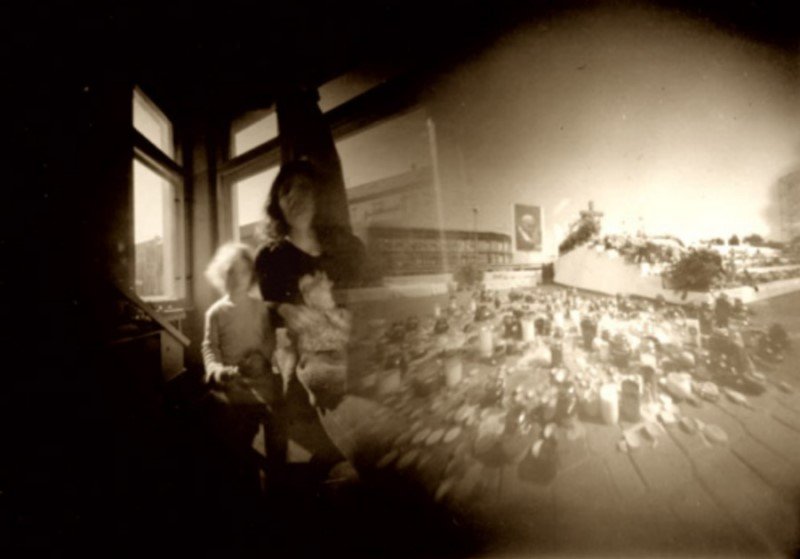
There are two places in this photograph at once.
On the left, a woman and a small child stand at a window in Berlin, Prenzlauer Berg, afternoon light. On the right lies a square covered in grave candles, hundreds of them, a portrait on the wall behind. That is Warsaw, some five hundred kilometres further east. In the middle the two halves run into each other, because they are on the same piece of film.
Patrick Brinkschulte exposed one half. Stanislaw Kulawiak exposed the other. They did not know each other. Neither of them saw what the other had photographed until the negative was developed. It was early April 2005, John Paul II had died two days before, and the two of them had each bought a hole on eBay.
Hole number 1 and hole number 2.
A man who got as far as 5,607,249
To understand why there were holes with numbers on them, you have to go to Warsaw, forty years earlier.
In 1965 the Polish painter Roman Opałka began painting numbers. He started at 1. He painted them in white, in rows, on canvases all exactly the size of his studio door. Each new canvas picked up where the last one stopped. Into the ground he mixed one percent more white every time, so that eventually the numbers would be white on white. After every session he photographed his own face, the same pose, the same light. And he spoke each number aloud onto tape as he painted it, in Polish.
He called the work 1965/1-∞.
There was only one way it could end, and that is how it ended. Roman Opałka died on 6 August 2011. The last number he painted is 5,607,249. 231 paintings, 46 years, and the goal was never reachable. That was the point.
Two holes instead of one number
In February 2005, Przemek Zajfert and Burkhard Walther dedicated a project to that work, and changed exactly one thing about it.
Opałka counted alone. They counted in pairs. Every number needed a second number, and every second number needed a second person. They built a camera obscura with two holes side by side, 73 millimetres apart, and auctioned both holes simultaneously on eBay, once a week. Two highest bidders, anywhere in the world. First one of them got the camera, then the other.
Those 73 millimetres are the whole idea. The gap is small enough that the two fields of view overlap. So the two exposures do not sit tidily next to each other like a diptych, they reach into one another. Which means neither person can make their picture without handing half of it to a stranger.
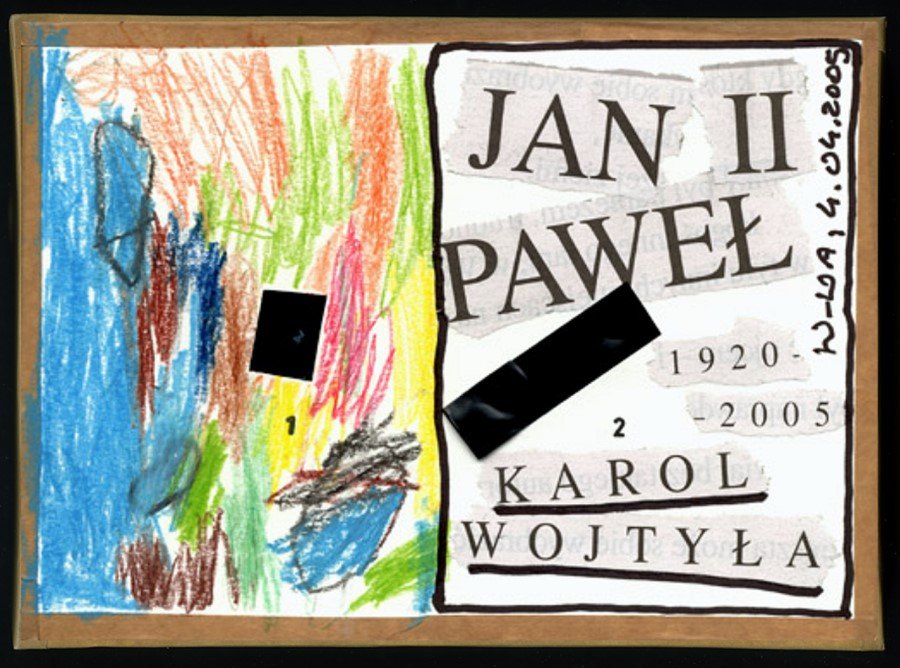
The same camera from the front, back in the archive. On the left the Berlin half, on the right the Warsaw one, each hole sealed with a strip of black tape exactly as the instructions required. A date is written by hand along the edge: 4.04.2005.
A cardboard box, 80 grams, one dollar thirty-four
The camera was not a device. It was a light-tight cardboard box painted black inside, 147 by 202 by 37 millimetres, eighty grams, with a piece of 13 by 18 centimetre sheet film glued in. Two marks on the front and two stamped numbers. When it shipped, it had no hole at all.
You pierced the hole yourself. The needle was in the box. The instructions were four sentences long:
- Carefully pierce the hole with the needle and cover the opening with a finger at once.
- Position the camera and uncover the hole.
- Expose.
- Cover the hole with your finger again and tape it shut with the black tape.
Everything the project had to offer sat inside that one word, "expose". Sun: fifteen to thirty seconds. Sun and cloud: thirty seconds to a minute. Overcast: two to ten minutes. Indoors: an hour to several hours. A hole of 0.35 millimetres, an angle of view of 115 degrees, and otherwise patience.
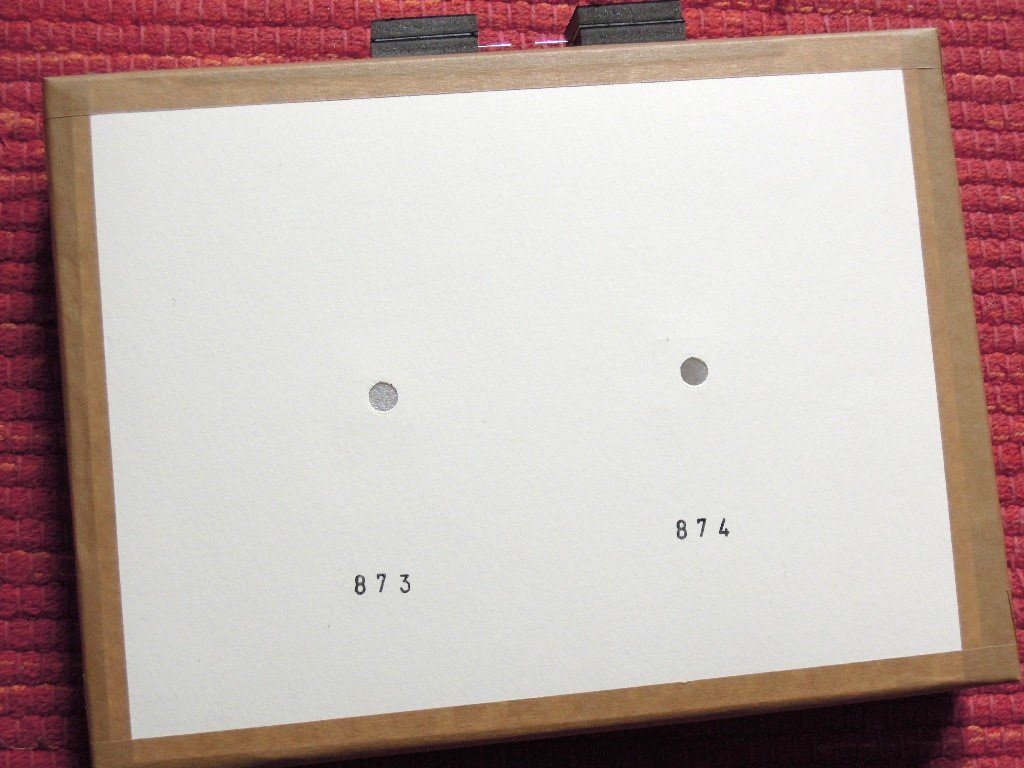
Camera number 873 and 874, both holes pierced, both pictures already in the film and still invisible. Photo: Przemek Zajfert.
It was all sold on eBay, weekly, listed as "Pinhole #889 Project Camera Obscura 2005/1-Inf, dedicated to Roman Opalka". Starting price one dollar thirty-four, free shipping, located in Germany. In the screenshot Przemek kept of one of those auctions, both lots show zero bids.
A work of art for a dollar thirty-four, and nobody bidding. It is the most honest number in this whole story, and it does not change the fact that more than a thousand people ended up taking part.
What came back
The exposed cameras went back to Stuttgart, were developed, and stayed in the archive. What accumulated there over the years is a strange world map made of accidental pairs.
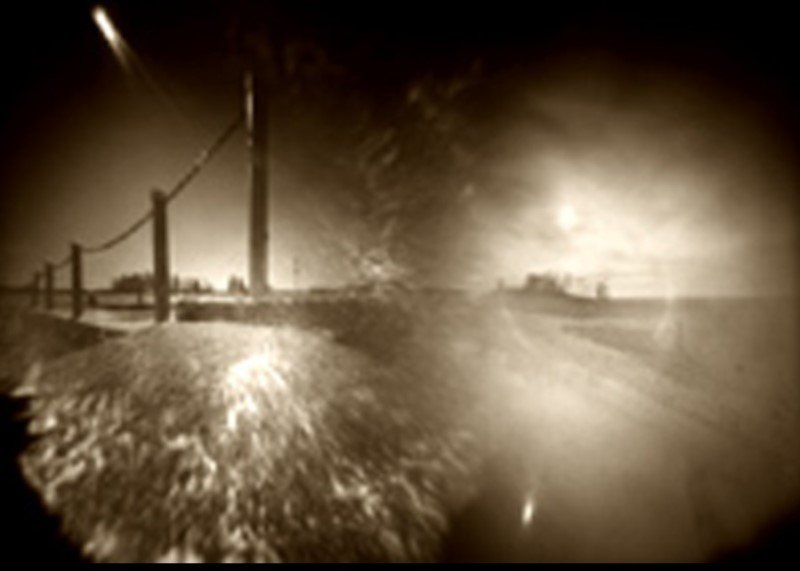
Pinhole #75 and #76: Keith Fyfe in Sydney and Steven Schmiedeskamp in Lincoln, Nebraska. Two continents, one horizon.
Numbers 75 and 76 went to Sydney and to Lincoln, Nebraska, sixteen thousand kilometres apart. Both of them photographed outdoors, into flat country, against a low sun. The halves fit together so well you could take the result for a single landscape. Nobody arranged that. There was no way to arrange it.
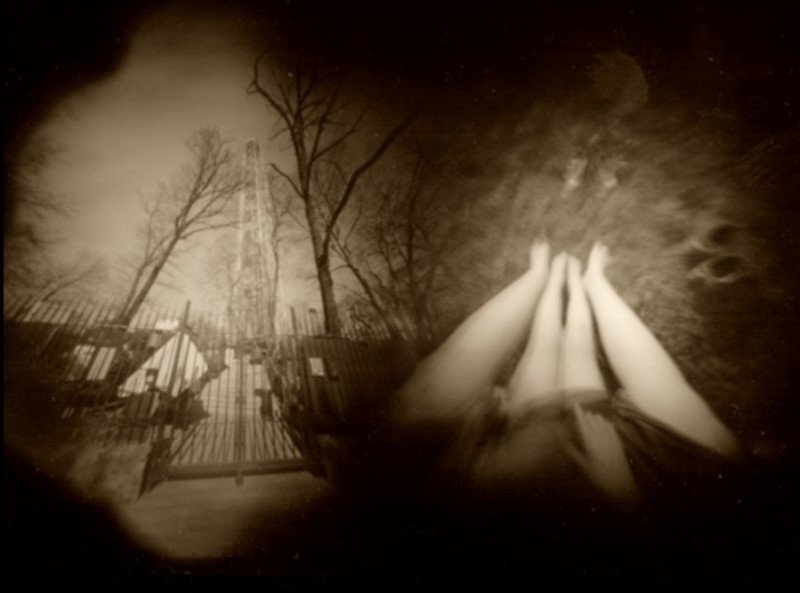
Pinhole #99 and #100: Armando Moneta in Milan and Corinne Costantini in Plérin. Their title is recorded in the archive: "Elle. Le fruit qu'on fit dans le jardin du monde."
Numbers 99 and 100 are the opposite. On the left a winter gate in Milan, bare branches, a lattice tower. On the right, on the Breton coast, a body in the light. A man photographs a closed-up city and, without doing anything at all, gets a human being in the same picture. That is no longer photography that belongs to somebody.
Two people who never met made a picture together, and could not have prevented it.
2,072
At the top of the archive index sits the last pair: Pinhole #2071 and #2072.
Two thousand and seventy-two holes. A little over a thousand cameras, a thousand pairs, twenty years of two auctions a week, two addresses, two envelopes, one negative developed, one entry in the archive. In 2025 the project was closed.
A project with the infinity sign in its name was given an end. You could call that a failure. I think it is the opposite, and Opałka had already given the answer in 1965: 1-∞ is not a number you arrive at. It is a direction you point in.
The difference between the two endings still matters. Opałka's work ended because one person had to stop. It was tied to his hand, and it went with him. The other project ended because twenty years of weekly auctions, envelopes and darkroom is eventually enough. But it was never tied to one hand. Two thousand holes were pierced by strangers' fingers.
Something built for infinity has to be able to be handed on. Otherwise it stops with a person.
What Both In Time takes from it
None of this started in 2005. It started in 1999, when Przemek built the first camera obscura with two holes, one for Stuttgart and one for Berlin, because two artists were too far apart to make a picture together. Six years later that improvised fix became a worldwide project, and twenty years later a camera you can give away.
What stayed the same:
Two holes, side by side, close enough that the pictures overlap. One negative. Two people. The hole is pierced by hand with a needle that comes in the box, and taped shut after the exposure. And the part no technology can replace: until both people are done, nobody sees anything.
What changed, deliberately:
You choose the second person. In 2005 eBay chose. An algorithm and a highest bid threw two strangers together. That was the appeal, and it was also the limit: you could not dedicate the picture to anyone. With Both In Time you decide who exposes the second half. Your brother. Your daughter in eighteen years. Or a stranger after all, if you prefer it that way.
You set the wait. Back then roughly a week passed between the two exposures, because the next auction cycle was waiting. With Both In Time the waiting is not a side effect, it is the actual material. Some people pass the camera on after three weeks. Some put the seal sticker on it, write a date across it, and open it for an eighteenth birthday.
The picture stays with you. The 2005 cameras went into the archive, and that is where they still are. Rightly so, it was a body of work. Your camera goes nowhere. It belongs to the two people who exposed it.
You develop it yourself. Back then developing happened in Stuttgart, by someone who had been doing it for decades. Today the Caffenol recipe is in the box: instant coffee, vitamin C, baking soda, under five euros for all of it, five minutes in your kitchen under red light. The moment the image rises out of the paper no longer belongs to the artist. It belongs to you.
It is photo paper, not film. 10 by 15 centimetres, a 0.3 millimetre hole, pierced with an acupuncture needle. Four seconds to several hours, depending on the light. The rest is the same.
The count starts at 1 again
Every Both In Time camera is built by hand in Stuttgart and carries its own number, stamped, running from 0001.
Not from 2073. We are not continuing where the old project stopped, because that was a finished work and it belongs to two artists and a thousand strangers. The new count starts at one, the way Opałka started at one and the way 2005 started at one.
That is all infinity means in practice: that somebody after you starts at one again.
The man who spent twenty years posting cardboard boxes to strangers now builds a camera you can put into somebody's hands. Two holes, one negative, and this time you choose who makes the other half.
From one to infinity. And then onwards, with somebody else.